A Courageous Ambassador
Remembering Ouachita, AIC pioneer Robert Cornelius
 February 24, 2026
- Chase Hartsell
February 24, 2026
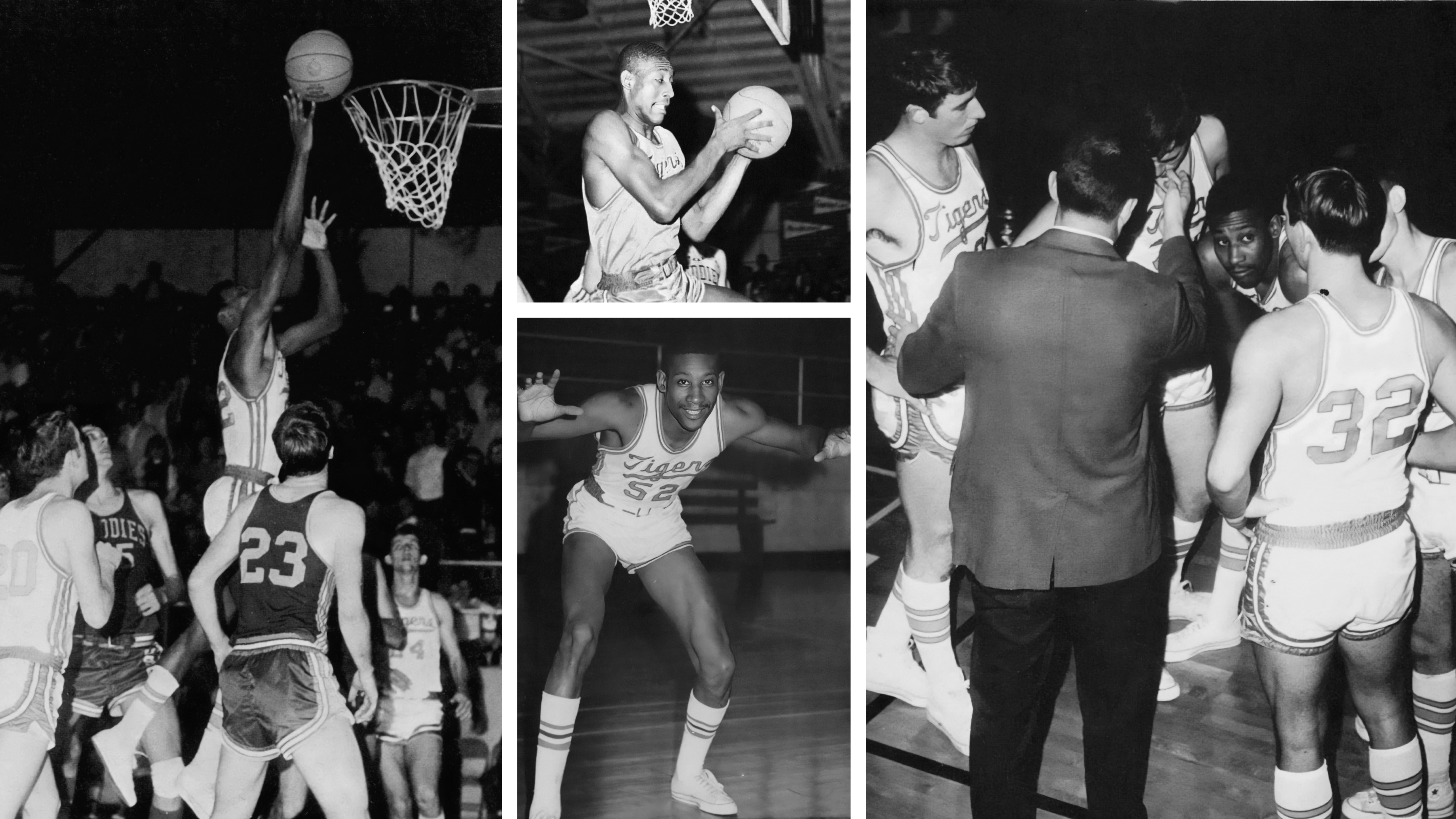
- Chase HartsellIt’d have been easy for Robert Cornelius to feel pressure as he stepped onto Ouachita’s campus for his first semester in the fall of 1965.
Just one year prior, the university admitted Gustine Blevins, Gloria Fallin and Carolyn Green as its first African American students. Now, Cornelius was set to break the color barrier for not only Ouachita’s athletics program but the entire Arkansas Intercollegiate Conference.
Add in the fact that Bill Vining Sr., the Tigers’ head basketball coach, had brought Cornelius to Arkadelphia to succeed center Leon Clements, Ouachita’s first basketball All-American and the AIC’s all-time leader in points and rebounds, and the lights couldn’t have been brighter.
But the freshman didn’t mind. He’d played under bright lights in 1963, when he helped his previous Tiger basketball team at Lincoln High School in Camden, Arkansas, capture Arkansas’ Black state championship to earn a bid to the National Interscholastic Athletic Association tournament. A Tennessee Historical Commission plaque at the event’s former host site, Tennessee State University (then known as Tennessee A&I), describes it as the “foremost basketball tournament for African American players from across the South and the Midwest.” Though Lincoln lost in the first round to eventual semifinalist Crestwood of Norfolk, Virginia, the Tigers represented their hometown and state well.
Cornelius’ character and uncommon skill set, which included left-handed dribbling, dunking and playing up-tempo offense and defense, caught the eye of Vining. Two years after the NIAA tournament, Ouachita’s head coach invited Cornelius to campus for a tryout.
“We were glad to have him there,” said Larry Bone, a 1967 graduate and member of the men’s basketball team at the time. “He filled a real need we had.”
Vining and his family agreed.
“Robert was a good fit for the team,” said Bill Vining Jr., Coach Vining’s son and a Ouachita Athletics Hall of Famer in his own right. “He just tried to fit in and play ball.”
Unfazed by the fact that no AIC team had ever featured an African American student-athlete before, Vining successfully recruited the Camden native to be a part of his program’s young core for the 1965-1966 season.
Cornelius’ arrival, however, was not without its challenges. For example, Bone asked to share a dorm room with Cornelius during his first year on campus, but the request was denied. Though Bone was disappointed that his teammate had to live in a room by himself, he said that Cornelius “always dealt with things like that with class.” The two ended up rooming together on team road trips, leading to a lifelong friendship.
On more than one of those road trips, businesses refused to serve Cornelius. The team’s policy in response? If the business turned away one team member, it turned away the entire team.
“There was always concern about the reaction of players, fans and crowds on the road,” said Ken Wasson, a 1974 Ouachita alum from Arkadelphia who spent his teenage years watching Cornelius. “Robert was a good ambassador for Ouachita on the road and at home. It took courage on his part.”
That courage paid off. The 1966 Ouachitonian yearbook noted that, although he had been “used sparingly in early games,” Cornelius soon became “a fixture at center” in the team’s starting lineup. He finished the regular season second on the team in points (12.7 per game) and rebounds (9.6 per game), quickly becoming a fan favorite in the process.
“Every time he got in the game, the crowd was cheering,” Wasson said of Cornelius. “They were really behind him and proud of him.”
“He picked up friends really quick on campus,” Bone said. “There were a lot of kids who enjoyed being with him. He liked everybody, and as people got to know him, they respected him.”
The freshman center played a critical role in the Tigers’ turnaround during the second half of the season, when his squad improved from an 8-9 start to a 17-10 record ahead of the postseason. Ouachita entered the NAIA District 17 Tournament with a first-round bye as the AIC’s No. 3 seed. In the first minute of the Tigers’ quarterfinal showdown with John Brown, Cornelius severely sprained his ankle, forcing him to miss the rest of the game. His teammates fought valiantly, but without Cornelius and fellow freshman standout James Chancellor (who had fouled out at the 11:08 mark in the second half), Ouachita fell behind late and ultimately suffered a 96-84 loss.
Though the Tigers did not achieve the outcome they had hoped for, the Ouachitonian wrote that the underclassmen-heavy 1965-1966 team had “earn[ed] the respect of all Tiger fans” by refusing to give up in the face of unfavorable odds. Cornelius, too, had earned the respect of his peers, becoming the first African American honoree in conference history with his selection to the 1966 All-AIC Honorable Mention Team.
Over the next three seasons, Cornelius finished top 10 in the conference for both scoring and rebounding at least twice, resulting in Second Team All-AIC recognition in 1967. Along the way, the men’s team continued to welcome African American student-athletes, including Tommy Patterson and Jimmy Beard (with the former later becoming an NBA draft pick). Cornelius finished his Ouachita career with 815 rebounds, making him one of only three players in program history to eclipse 800.
Bone explained that Cornelius was a dedicated political science major, enjoying classes under faculty like Dr. Bob Riley. Though he did not initially finish his degree before departing in 1969 to serve in Vietnam, Cornelius returned to the university in 1982 and earned his Bachelor of Arts in political science. He used the skills he developed through his studies to serve his community in Crossett, Arkansas, through leadership roles such as Sunday school superintendent and school board president.
While at Ouachita, Cornelius also met Emma Jean Crow, an elementary education major from Gurdon, Arkansas, who graduated in 1969. The two married and enjoyed a union that lasted more than 50 years.
In February 2010, Cornelius was inducted into the Ouachita Athletics Hall of Fame in a ceremony held at Walker Conference Center. He was also included as part of the “First” exhibit in Green-Blevins Rotunda at McClellan Hall, which celebrates the pioneers in Ouachita’s campus integration after the passing of the Civil Rights Act of 1964.
Cornelius died on April 30, 2021, at the age of 75. In the 60 years since his freshman season, thousands of African American student-athletes at Ouachita and other universities across the state have followed the path he helped established. Beyond this legacy, he is remembered by those close to him as a great teammate on the court, in the classroom and in life itself.
Chase Hartsell ’24 is a content specialist in Ouachita’s Office of Communications & Marketing.
You Also Might Like

Recent